Key takeaways
- Verify the exact legal entity and website through the relevant regulator’s own records.
- Guaranteed returns, urgent deposit requests and demands for extra payments to release funds deserve scrutiny.
- Reviews, polished dashboards and responsive support are supporting evidence, not proof of legitimacy.
- Keep account credentials private and preserve records if you suspect fraud.
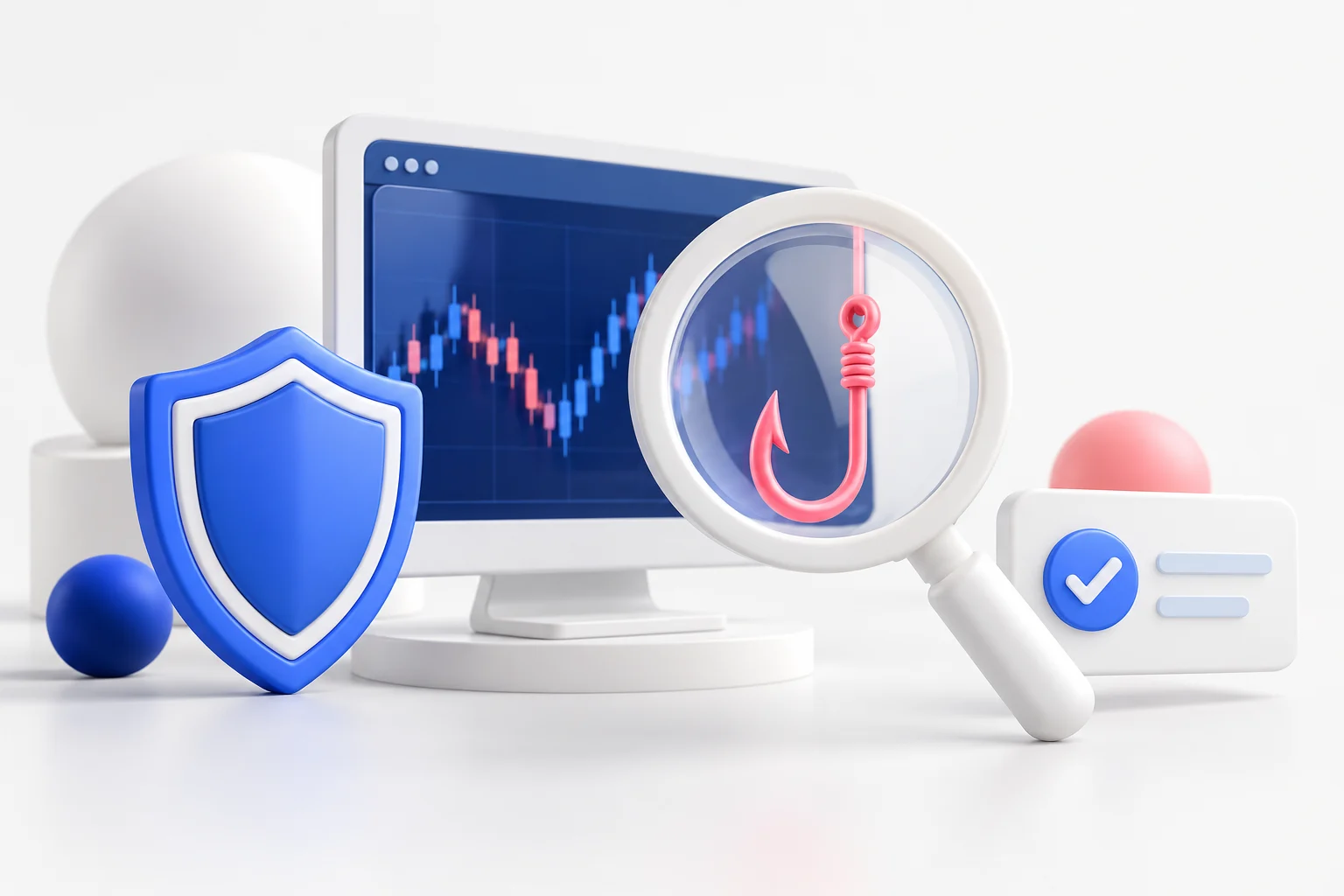
A convincing trading website is easy to build. Establishing who operates it, what they are authorised to do and how your money will be handled takes more work. That distinction matters before you deposit funds or share identity documents.
Broker fraud can involve a completely fictitious firm, an impersonator using a real company’s details, or a promoter selling an investment that does not exist. The aim of this guide is to help you ask better questions—not to suggest that any checklist can remove every risk.
Five patterns to watch for
1. Fake brokers and cloned firms
A clone may display the name and licence number of a genuine business while using a different website, email address or bank account. Search the official register independently and compare the contact details, permissions and legal name. A logo linking to a convincing-looking page is not enough.
The appropriate regulator depends on the provider, product and jurisdiction. A foreign licence is not automatically permission to offer services where you live, and authorisation does not guarantee investment returns.
2. Signal sellers promising certainty
A screenshot of a winning trade omits deposits, withdrawals, open losses, costs and unsuccessful recommendations. Ask what the claimed record includes and whether it has been independently verified. A fixed subscription price does not make a signal reliable; nor does a large following.
A provider promising profits without meaningful risk is selling a claim that trading cannot support. Do not hand over account access merely because someone offers to trade on your behalf.
3. Investment schemes built around recruitment
Promises of regular, unusually high returns combined with pressure to recruit friends are serious warning signs. A displayed account balance or an early withdrawal may be used to build confidence. Neither establishes that later withdrawals will be honoured or that genuine trading supports the returns.
4. Phishing and account impersonation
Messages may copy a broker’s branding and create urgency around verification or a password reset. Open the provider’s official app or independently confirmed website rather than following an unsolicited link. Use unique passwords and available multi-factor authentication. Never share verification codes, wallet recovery phrases or remote access to your device.
5. Paying to unlock a withdrawal
Be cautious when a new “tax”, “insurance fee” or “account upgrade” must be paid to a personal account or wallet before money can be withdrawn. Check the original agreement and independently contact the provider. Additional payments can deepen an existing loss.
A useful verification routine
Record the legal entity, regulator, licence number and approved website before funding an account. Read withdrawal conditions and costs. Compare these details with information obtained directly from official sources, and keep copies of the terms you accepted.
Independent reviews can reveal recurring complaints, but they can also be manipulated. Payment methods have different dispute processes; a card payment is not a guaranteed recovery mechanism, and a cryptocurrency payment alone does not prove fraud.
If something feels wrong
Stop sending additional money. Save messages, transaction references, screenshots and the website address. Contact your payment provider promptly to ask about the available options, then report the matter through the relevant regulator or law-enforcement channel. Be wary of anyone demanding an advance fee to recover lost funds.
DeuxProTrader has an affiliate relationship with Deriv. That relationship is disclosed on this website and should never replace your own checks of the entity, terms and protections applicable to your account.
Before you deposit
- Match the provider’s legal name, domain and contact details with official records.
- Read the funding, withdrawal and complaint procedures.
- Reject promises of guaranteed trading returns.
- Keep a record of your checks and revisit them when the account’s terms change.
Turn understanding into practice.
A demo lets you explore a platform with virtual funds. It does not reproduce every condition of live trading.
Explore Deriv’s demo ↗Affiliate link. We may earn commission from referrals.